
Marketing automation consulting services help businesses turn scattered digital marketing activity into a clear, measurable system for attracting leads, nurturing prospects, and supporting sales. For small businesses in and around St. Louis, MO, working with an automation consultant can make marketing more consistent without forcing the owner or team to manually manage every email, follow-up, and campaign task. This guide explains how marketing automation works, where consulting adds value, and how to choose an approach that supports local growth.
In this article
- What do marketing automation consulting services actually do?
- The core business benefits of marketing automation
- Consulting turns tools into a practical marketing strategy
- How does automation improve lead generation?
- Email marketing becomes more relevant and timely
- Sales automation supports faster, cleaner follow-up
- Local SEO and automation work together in the St. Louis market
- What should a business automate first?
- Signs you may need automation consulting
- Choosing the right consulting approach
- A simple checklist before you automate
- Measuring success after implementation
- FAQ
What do marketing automation consulting services actually do?
Marketing automation consulting services help a business plan, build, improve, and manage systems that automate key parts of its marketing and sales process. That can include email marketing workflows, lead generation funnels, customer segmentation, CRM organization, campaign tracking, and sales automation tasks that keep prospects moving toward a decision.
A consultant does more than install software. The real value is connecting the tool to a practical marketing strategy. Without that strategy, automation can become a pile of disconnected emails, forms, tags, lists, and reports. With the right guidance, it becomes a repeatable process that helps the business communicate with the right people at the right time.
For a St. Louis-area business, this might mean building a local lead capture campaign for people searching for services in St. Louis, Chesterfield, Edwardsville, Collinsville, O’Fallon, or nearby Metro East communities. It could also mean creating an automated follow-up sequence for prospects who request a quote, download a checklist, book a consultation, or visit an important service page.
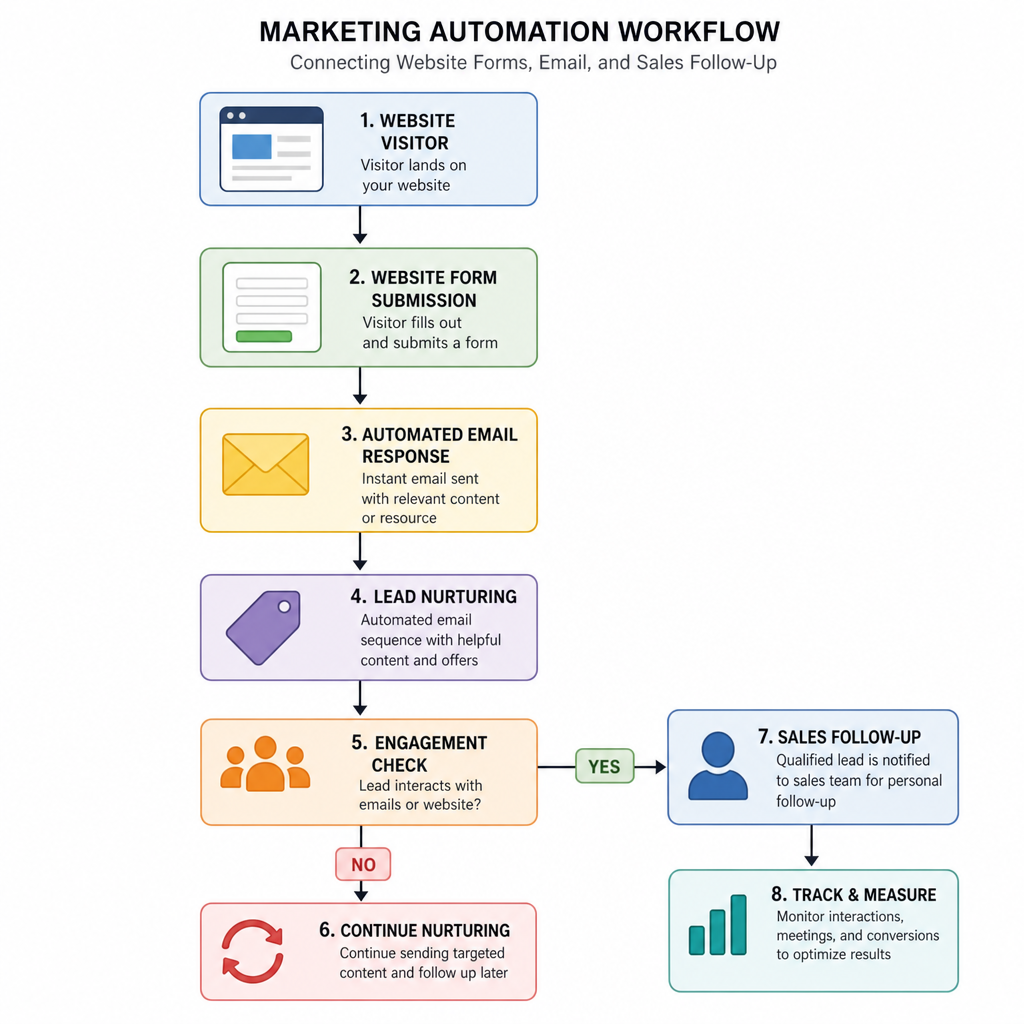
The core business benefits of marketing automation
Marketing automation is not about replacing personal relationships. It is about protecting them from missed follow-ups, inconsistent messaging, and manual work that slows growth. When the system is built around the customer journey, automation helps a business stay visible and useful from first contact through the final buying decision.
The most important benefits usually fall into a few categories:
- More consistent lead follow-up: New inquiries can receive an immediate confirmation, helpful next steps, and timely reminders without waiting for someone to manually respond.
- Better use of email marketing: Instead of sending the same message to everyone, businesses can send more relevant emails based on interests, behavior, location, or stage in the buying process.
- Stronger lead generation: Forms, landing pages, checklists, and campaigns can be connected so new contacts are captured and organized automatically.
- Improved sales automation: Sales teams can receive task reminders, lead notifications, pipeline updates, and follow-up prompts that reduce the chance of losing a warm prospect.
- Clearer reporting: Campaign performance, lead sources, email engagement, and conversion points can be tracked more consistently.
- Less repetitive work: Routine marketing tasks can be automated, giving business owners and teams more time for strategy, service delivery, and customer relationships.
These benefits become especially useful for small businesses that do not have a large in-house marketing department. A local company competing in the St. Louis market may need strong digital marketing, but it may not have time to manually build every email, segment every contact, and monitor every lead source. Automation makes that work more manageable.
Consulting turns tools into a practical marketing strategy
Many businesses already have pieces of a marketing automation system. They may use an email platform, a CRM, contact forms, paid ads, social media, a scheduling tool, or sales pipeline software. The problem is that those pieces often do not work together.
Automation consulting helps bring order to the system. A consultant can review what is currently in place, identify gaps, simplify unnecessary complexity, and create a plan that matches the business model. The goal is not to automate everything. The goal is to automate the right things in the right order.
A strong marketing strategy usually answers questions like:
- Who is the ideal customer?
- What problem are they trying to solve?
- What local search terms or digital marketing channels bring them in?
- What should happen after they submit a form, call, schedule, or download a resource?
- What information do they need before they are ready to buy?
- When should sales follow up personally?
- How will the business measure whether the process is working?
This strategy-first approach prevents automation from feeling robotic. It also helps ensure that every message has a purpose, whether it is educating a new lead, reminding a prospect to take the next step, re-engaging an inactive contact, or helping a current customer understand additional services.
How does automation improve lead generation?
Automation improves lead generation by making it easier to capture, organize, and follow up with prospects as soon as they show interest. Instead of treating every website visitor the same, a business can offer useful next steps, collect contact information ethically, and continue the conversation through targeted email marketing and sales follow-up.
For example, a St. Louis-area small business might offer a free resource to people comparing local service providers. When someone downloads that resource, automation can add the contact to the right list, send the checklist, notify the sales team, and begin a short nurture sequence. The prospect gets helpful information quickly, and the business gains a structured way to build trust.
Effective lead generation automation may include:
- Local landing pages for specific services or St. Louis metro communities.
- Lead magnets such as checklists, planning guides, calculators, or comparison sheets.
- Website forms that route contacts based on service interest or location.
- Email nurture sequences that answer common buyer questions over several days or weeks.
- Retargeting audiences based on website visits or content engagement.
- CRM tagging that separates new leads, warm prospects, customers, and referral sources.
The best systems are simple enough to maintain but detailed enough to support meaningful follow-up. If every lead receives the same generic message, automation will not reach its full potential. If every lead is segmented into dozens of complicated paths too soon, the system can become hard to manage. Consulting helps find the middle ground.
Email marketing becomes more relevant and timely
Email marketing is often one of the first places businesses feel the benefits of automation. A manual newsletter can still be useful, but automated emails help deliver the right message based on what a person did or requested. That context makes the communication more helpful.
A prospect who downloaded a small business marketing checklist should not receive the same first email as someone who requested a sales call. A past customer should not be treated like a brand-new lead. Someone researching digital marketing services in St. Louis may need different information than someone who is already comparing proposals.
Useful email marketing automations can include:
- A welcome sequence for new subscribers.
- A delivery email for a free checklist or guide.
- Follow-up emails after a contact form submission.
- Educational emails that explain services and common mistakes.
- Re-engagement campaigns for inactive contacts.
- Post-purchase or post-project emails that support retention and referrals.
The consulting role is to map the message to the moment. That includes writing or organizing the content, setting the timing, defining the audience, and deciding when a person should be moved into another workflow. Done well, automated email feels less like a blast and more like a helpful conversation.
Sales automation supports faster, cleaner follow-up
Marketing automation and sales automation work best when they support each other. Marketing creates awareness and interest. Sales turns qualified interest into conversations, proposals, and customers. When the handoff is unclear, leads can fall through the cracks.
Sales automation can help by creating tasks, reminders, lead scores, pipeline stages, and notifications. For instance, if a lead from St. Louis fills out a high-intent quote form, the system can alert the right person immediately and create a follow-up task. If the lead opens several emails or visits a pricing or service page multiple times, the sales team can receive a signal that the prospect may be more engaged.
This does not remove the need for human judgment. It gives the sales team better timing and better context. Instead of guessing who to call next, they can prioritize people who have already shown meaningful interest.
A practical sales automation setup might include:
- New lead alerts sent to the right team member.
- Follow-up task reminders after calls or consultations.
- Pipeline stages for inquiry, qualified lead, proposal, decision, and closed customer.
- Automated internal notes when a contact takes an important action.
- Lost-lead or no-response sequences that keep communication professional.
For small teams, these details matter. A missed follow-up can mean a lost opportunity, especially in competitive local markets like St. Louis, where prospects often compare several providers before choosing.
Local SEO and automation work together in the St. Louis market
Marketing automation is even more useful when it supports a strong local search presence. If people find a business through local SEO, Google Business Profile, local service pages, map results, organic search, or St. Louis-focused content, the next step should be easy and trackable.
For businesses located near St. Louis, including those based in Troy, IL, local intent should shape both the content and the follow-up. A visitor searching for help “near St. Louis” may be looking for a provider who understands the local market, serves both Missouri and Illinois communities, and can respond quickly. Automation can help capture that interest before it disappears.
Local SEO best practices that pair well with automation include:
- Create service pages that clearly mention the areas served, such as St. Louis, MO, Metro East, Troy, IL, and nearby communities when accurate.
- Use location-aware calls to action, such as requesting a local consultation or downloading a small business marketing checklist.
- Connect contact forms to the CRM so leads are tagged by location and service interest.
- Track which local pages, search terms, or campaigns are producing qualified leads.
- Follow up with messaging that reflects the buyer’s local context instead of sending generic national copy.
- Keep Google Business Profile, website contact information, and service area language consistent.
Local search brings people to the door. Automation helps continue the conversation after they arrive.
What should a business automate first?
A business should automate the moments where delay, inconsistency, or repetitive work is most likely to cost leads or waste time. For many small businesses, that means starting with lead capture, email follow-up, CRM organization, and sales reminders before moving into more advanced workflows.
A good first-phase automation plan often includes:
- Lead source tracking: Identify whether inquiries come from organic search, paid ads, referrals, social media, local pages, or email campaigns.
- Contact form follow-up: Send an immediate confirmation and set expectations for what happens next.
- Checklist or lead magnet delivery: Provide the promised resource instantly and begin a short nurture sequence.
- CRM segmentation: Tag contacts by location, service interest, and lifecycle stage.
- Sales task creation: Remind the team to call, email, or review a lead within a defined timeframe.
- Basic reporting: Review which campaigns generate leads and which leads become real opportunities.
Starting small is usually smarter than building a complex system all at once. Once the foundation is working, the business can add advanced segmentation, lead scoring, customer retention workflows, referral campaigns, and more detailed reporting.
Signs you may need automation consulting
Some businesses can set up basic email marketing or CRM tools on their own. Consulting becomes more valuable when the system affects growth, sales, customer experience, or team efficiency. If marketing activity is increasing but results feel hard to track, that is often a sign the process needs structure.
Common signs include:
- Leads come in from several places, but no one knows which sources perform best.
- Prospects receive slow or inconsistent follow-up.
- Email lists exist, but campaigns are irregular or untargeted.
- The CRM has duplicate contacts, missing fields, or unclear stages.
- Sales and marketing teams use different information.
- Manual tasks are taking time away from higher-value work.
- Local campaigns for St. Louis or Metro East are running, but conversions are difficult to measure.
- The business has marketing software but is only using a small part of it.
Automation consulting can help diagnose the issue before more money is spent on ads, tools, or disconnected campaigns. Often, the biggest improvement comes from clarifying the process rather than adding another platform.
Choosing the right consulting approach
The right consultant should understand both marketing strategy and implementation. A strategy-only plan may look good on paper but fail in the software. A tool-only setup may function technically but fail to support lead generation or sales goals. The best fit combines planning, practical execution, and clear communication.
When evaluating automation consulting, look for an approach that includes:
- Discovery: A review of your business model, customers, current tools, local market, and sales process.
- Journey mapping: A clear outline of how people move from awareness to inquiry to customer.
- Workflow planning: Specific recommendations for email marketing, CRM updates, sales automation, and reporting.
- Implementation support: Help building forms, lists, tags, automations, integrations, and templates.
- Testing: Confirmation that contacts enter the correct workflows and receive the right messages.
- Training: Guidance so your team understands how to use and maintain the system.
- Optimization: Ongoing review of performance, bottlenecks, and opportunities for improvement.
For St. Louis-area businesses, local understanding is also useful. A consultant who considers how people search in the St. Louis metro, how service-area language should appear on the website, and how local leads should be routed can build a more practical system.
A simple checklist before you automate
Before investing in marketing automation consulting services, take time to clarify what you already have and what you need the system to accomplish. This makes the consulting process faster and more productive.
Use this quick preparation checklist:
- Identify your top services and most profitable customer types.
- List the cities or neighborhoods you serve, including St. Louis, MO, Troy, IL, and surrounding areas when relevant.
- Review your current website forms and calls to action.
- Gather existing email lists, CRM data, and campaign reports.
- Note where leads are currently being lost or delayed.
- Write down the questions prospects ask before buying.
- Choose one primary conversion goal, such as consultation requests, quote requests, checklist downloads, or booked calls.
- Decide who on your team should receive lead alerts and sales tasks.
If you want a practical starting point, download the free small business marketing checklist. It can help you review your current digital marketing foundation before you build a more advanced automation system.
Measuring success after implementation
Marketing automation should be measured by business outcomes, not just software activity. Open rates and clicks can be helpful, but they do not tell the whole story. A stronger system connects marketing activity to lead quality, sales conversations, booked appointments, proposals, and customer growth.
Useful performance indicators include:
- Number of new leads by source.
- Conversion rate from landing page visitor to form submission.
- Email engagement by segment or workflow.
- Speed of sales follow-up.
- Number of qualified leads created.
- Lead-to-customer conversion trends.
- Revenue or opportunity value influenced by campaigns, when trackable.
- Performance of St. Louis-focused pages or local campaigns.
Regular review matters because automation is not a one-time project. Buyer behavior changes, offers change, services change, and local competition changes. The system should be refined as new data becomes available.
FAQ
Is marketing automation only for large companies?
No. Small businesses can benefit from automation when they use it to solve practical problems like slow follow-up, inconsistent email marketing, messy contact lists, or unclear lead tracking. The key is starting with a simple system that matches the size of the team and the sales process.
Can automation help a local St. Louis business get more leads?
Yes, when it is connected to a strong local marketing strategy. Automation can support St. Louis-focused landing pages, checklist downloads, quote requests, CRM tagging, email nurture sequences, and sales reminders so local prospects receive timely follow-up.
Will automated email make my business sound impersonal?
Not if the workflows are written and segmented carefully. Good automation uses helpful timing, relevant content, and clear next steps. It should support personal communication, not replace it.
What should I do before hiring an automation consultant?
Review your current website, email list, CRM, lead sources, and follow-up process. You can also start with the free small business marketing checklist to identify gaps in your digital marketing foundation before planning automation.
How soon should a business automate sales follow-up?
Sales follow-up is often one of the first areas to automate because delays can cost opportunities. Even a simple alert, task reminder, or confirmation email can create a more reliable experience for new leads.
Build a smarter marketing system
Marketing automation consulting services give small businesses a practical way to connect digital marketing, email marketing, lead generation, and sales automation into one clearer process. For companies serving St. Louis, MO, Troy, IL, and the surrounding metro area, the right system can make local campaigns easier to track and follow-up easier to manage.
Start by reviewing what is already working, where leads are getting stuck, and which repetitive tasks are slowing your team down. Then use automation to support the moments that matter most. To begin, download the free small business marketing checklist and use it to evaluate your marketing foundation before your next campaign or automation project.
Ready to automate your marketing?
Book a free strategy call to discuss your current marketing operations and opportunities for smarter growth.
Book Your Call