
If you run a business in Troy, IL or anywhere in the Metro East, you have probably heard the phrase "sales funnel" thrown around by marketers. The truth is, a sales funnel builder in 2027 is not just a landing page tool with an email follow-up bolted on. It should tie together lead capture, qualification, automation, pipeline visibility, reporting, and the handoff to sales — all in one connected system. This guide is written specifically for small businesses in and around Troy, Illinois, so you can choose sales funnel software that actually fits how local buyers find and hire you.
What should a sales funnel builder do in 2027?
For a Troy, IL service business, a sales funnel builder should turn interest into leads, phone calls, booked jobs, and repeat customers. In plain terms, it should help you build a lead generation funnel, define the next step for every prospect, show where each lead sits in your process, and give you data you can act on.
This matters more than ever because the way people in the Metro East choose a business has changed. A homeowner in Edwardsville might find you through a Google search, check your reviews, read a blog post, see your name on social media, and then finally call — sometimes weeks later. A good funnel keeps you in front of that person at every step instead of hoping they remember you.
The right tool depends on your business. A solo contractor in Troy may just need speed and simple follow-up. A growing team serving Collinsville, Highland, and O'Fallon may need lead routing, scoring, reports, and sales pipeline software. A larger operation may care most about permissions, tracking, and CRM structure.
The main types of funnel builders
Rather than ranking specific products, it helps to understand the main categories. Each one fits a different type of business, team size, and reporting need — and the best fit for a Troy, IL small business is not always the most expensive option.
All-in-one funnel platforms
A marketing funnel builder bundles landing pages, forms, email, automation, checkout, and reporting into one tool. It works well for small local businesses that want to launch quickly without stitching several tools together.
The upside is speed. You can map out your offer, build a page, connect a form, trigger a welcome email, and measure results without a heavy setup. The tradeoff is that deeper sales work — custom deal stages, detailed tracking, or team permissions — can feel limited on these platforms.
Choose this path when you need to move fast, test an offer, or keep the buyer journey simple. Be cautious if your sales process involves multiple decision-makers, long nurture cycles, custom stages, or strict reporting requirements.
CRM-centered funnel systems
A CRM-centered setup starts with the customer record and builds the funnel around it. Marketing still matters, but the main goal is to keep every lead, call, activity, and deal stage in one place.
This works well for businesses that rely on consults, demos, quotes, or account-based selling. When set up properly, sales pipeline software shows which campaigns create real opportunities, which leads are stuck, and which follow-ups are overdue. It also helps marketing and sales work from the same facts.
The upside is alignment. Marketing can see what happens after a lead converts, and sales can see what content or source shaped the interest. The risk is setup — if fields, owners, and stages are messy, automation creates more confusion instead of less. For businesses in Troy setting up structured lead flows, dedicated lead management systems make sure every opportunity gets logged, tracked, and followed up on instead of slipping through the cracks.
Automation-first funnel builders
An automation-first system focuses on rules, triggers, segments, lead scoring, routing, reminders, and personalized journeys. It suits businesses that already have traffic and leads but need a better way to respond to them consistently.
An automated sales funnel can send messages based on behavior, alert your team, move records forward, or pause outreach when someone books a call. Used well, it keeps leads from falling through the cracks. This is where connecting your funnel to practical business automation workflows pays off — automating scheduling, quotes, contracts, and internal reminders so you spend time closing instead of doing manual admin.
The risk is over-automation. If every click creates a task, every segment gets a new sequence, and nobody reviews the workflow, the funnel becomes hard to trust. Good systems need clear logic, clean data, and regular review.
Content-led funnel builders
Some funnels are built around education rather than direct response. These tools support quizzes, resource libraries, webinars, newsletters, comparison pages, calculators, video series, or gated guides.
This path works when buyers need context before they are ready to talk — which is common for higher-ticket services in the Troy and St. Louis area. A content-led funnel gives prospects ways to learn on their own while giving you clear signals of interest.
In 2027 this matters even more because most buyers research on their own first. Pairing strong content with targeted email & SMS marketing campaigns lets you nurture those self-guided researchers into ready buyers over time.
How do you choose the best sales funnel builder for your business?
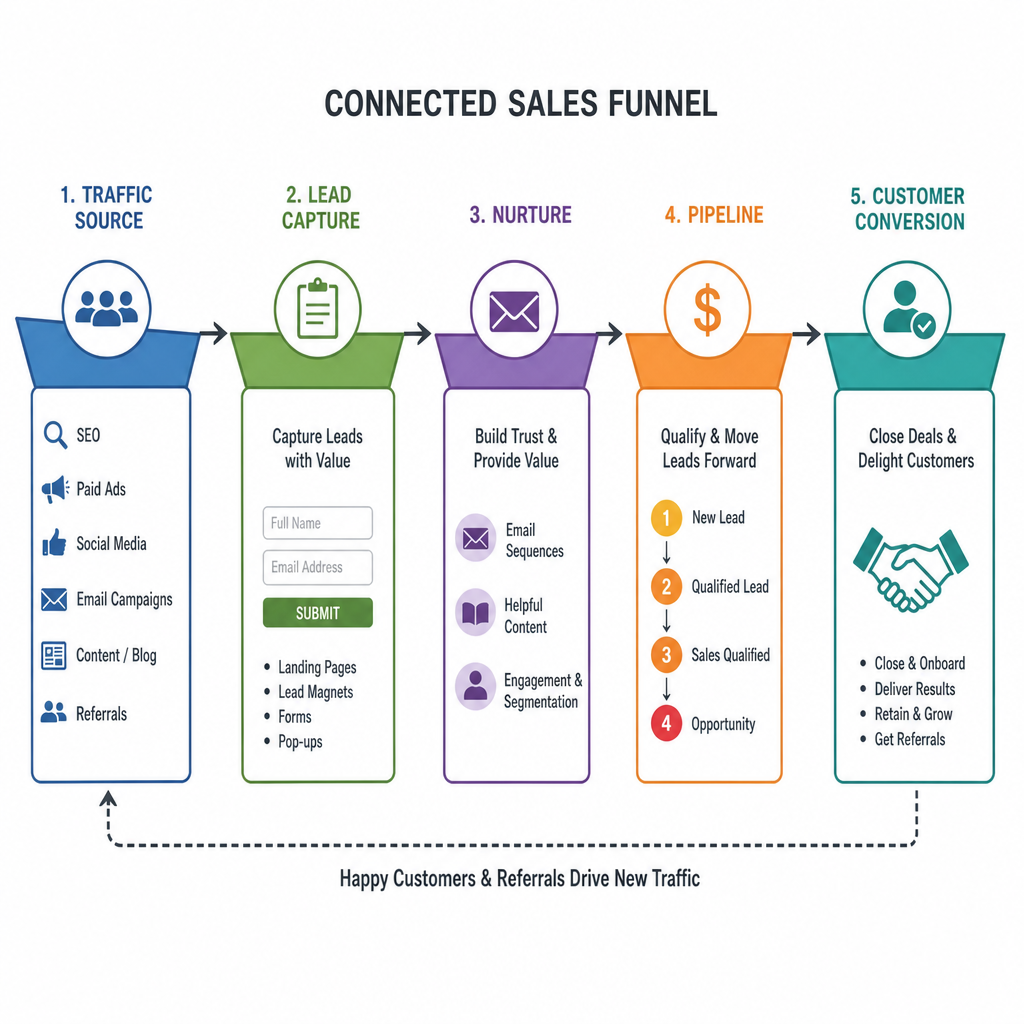
Choose the best sales funnel builder by matching the tool to how you actually sell — not by chasing the longest feature list. Start by mapping your customer journey, identify the steps that move leads forward, and pick software that streamlines those actions.
Use this checklist before you compare options:
- Offer type: Is the funnel built for a product, consult, demo, application, subscription, or long sales cycle?
- Lead source: Will traffic come from search, social, partners, events, outbound, referrals, or content?
- Sales involvement: Does a person need to screen, call, demo, quote, or negotiate before purchase?
- Automation needs: Which follow-ups must happen now, and which should stay human?
- Pipeline visibility: Can the team see lead status, deal stage, owner, next step, and source?
- Reporting needs: Do you need simple conversion rates, revenue tracking, cohort views, or rep-level results?
- Integration needs: Does it connect with your CRM, payment system, calendar, analytics, support desk, or data warehouse?
- Ease of ownership: Can your team build and maintain the funnel without outside help?
A good choice usually becomes clear once you map the real workflow. If your main problem is launch speed, an all-in-one platform may fit. If your main problem is follow-up discipline, sales pipeline software may matter more. If your main problem is lead quality, better forms, scoring, segments, and content paths may matter most. And if your foundation needs work, starting with high-converting web design ensures visitors who enter the top of your funnel actually convert.
Core features that matter more than flashy extras
Feature lists can be misleading. A platform may list dozens of tools and still fail at the few jobs your funnel does every day. Focus on the parts that support movement, measurement, and accountability.
The most useful features include:
- Flexible landing pages and forms: Your team should be able to build campaign pages, embed forms, test messages, and capture the right data without slowing each launch.
- Segmentation and lead scoring: Not every lead deserves the same response. Scoring and segments help separate casual visitors from high-intent prospects.
- Automated follow-up: Email, SMS, tasks, routing, and reminders can shorten response time and keep the experience steady.
- Pipeline tracking: A funnel does not end when a form is submitted. Good sales funnel software shows what happens after conversion, including calls, opportunities, proposals, wins, and losses.
- Analytics and attribution: You need to know which pages, sources, offers, and messages bring in qualified leads, not just clicks.
- Clean integration design: A funnel builder should cut manual work. If your team has to copy data between systems, the funnel is already leaking.
- Governance and permissions: As teams grow, access control, naming rules, approval flows, and audit trails become more important.
These are also the areas where AI can help. AI can speed up drafting, scoring, routing, and workflow suggestions — but clarity is key. Many teams are testing AI for growth and workflow speed, yet data quality and adoption remain real issues.
Common mistakes when building an automated sales funnel
The first mistake is building around the tool instead of the buyer. A funnel should reflect how people in Troy and the surrounding area find, evaluate, trust, and choose you. If a flow exists only because the software allows it, it may create noise instead of progress.
The second mistake is treating automation as strategy. An automated sales funnel can send messages, assign leads, and update fields, but it cannot fix a weak offer, unclear message, or poor qualification. Automation makes good systems faster and bad systems louder.
The third mistake is ignoring sales feedback. Marketing may celebrate volume while sales struggles with low-fit leads. A healthy funnel needs a feedback loop so the team can improve forms, scoring rules, content, targeting, and handoff rules.
Watch for these warning signs:
- Leads enter the funnel but no one owns the next step.
- Multiple workflows send mixed messages to the same person.
- Sales reps do not trust shaky lead scores or source data.
- Reports show form fills but not qualified opportunities.
- Every campaign creates new fields, tags, and lists with no cleanup plan.
- Prospects get generic nurture emails after asking for a direct talk.
A simple way to compare funnel builder options
Before you commit to a sales funnel builder, score each option against your real needs. A simple frame can stop overbuying and under-planning.
Use a five-part comparison:
- Build: How easily can your team create pages, forms, sequences, and offers?
- Capture: Does the system collect the data needed to screen and personalize?
- Nurture: Can it send useful follow-up based on source, behavior, stage, or fit?
- Convert: Does it support booking, checkout, proposals, demos, or sales handoff smoothly?
- Learn: Can you see where leads come from, where they stall, and what improves revenue?
This keeps the conversation grounded. A tool that is strong at page building but weak at pipeline reports may be fine for a simple campaign and wrong for a sales-led team. A CRM-heavy tool may be powerful for a revenue team but too much for a solo founder testing an offer.
The takeaway for 2027 planning
The best choice for 2027 is not the tool with the longest feature list. It is the best sales funnel builder for your buyer journey, follow-up process, and reporting needs — and for small businesses in Troy, IL, that usually means a system that connects local search, lead capture, and automated follow-up in one place.
If you are choosing sales funnel software this year, start with the process before the platform. Map the journey, define qualification, set ownership, and mark the points where automation can remove friction. Then select a sales funnel builder that helps your team create a cleaner, faster, and more measurable path from interest to action. For a broader, non-location-specific look at the same topic, see the full guide on Scalable Coaching Systems.
Questions & Answers
Should a small Troy, IL business choose an all-in-one funnel platform or a CRM-centered system?
A small business should usually start with the tool that solves the most urgent workflow problem. If the goal is to launch pages, forms, offers, and follow-up fast, an all-in-one funnel platform may be the better fit. If the business depends on consults, demos, proposals, or sales reps, a CRM-centered system may be more useful because it keeps lead status, ownership, activity, and deal stages in one place.
Why is pipeline visibility so important in a sales funnel builder?
Pipeline visibility shows what happens after someone becomes a lead. Without it, a team may only track form fills or campaign conversions, not the outcome of those leads. Good visibility helps marketing and sales understand lead quality, follow-up gaps, stalled prospects, and revenue sources.
How much automation should an automated sales funnel include?
Automation should support clear next steps, not replace judgment. Useful automation can trigger follow-up, route leads, create tasks, update stages, or pause outreach when someone books a call. Excessive automation causes problems when workflows overlap, lead scores are unreliable, or prospects receive irrelevant messages. The best approach is to automate repeatable actions while keeping qualification, strategy, and sales feedback human-led.
What role should AI play in a 2027 sales funnel builder?
AI can help with drafting, predictive scoring, chat-based routing, personalization, and workflow suggestions, but it works best when the funnel is already clear. If lifecycle stages, data quality, ownership rules, or qualification criteria are messy, AI may amplify those problems. Treat AI as a way to improve speed and relevance, not as a substitute for clean process design.
What is the simplest way to compare funnel builder options?
Use the five-part frame: Build, Capture, Nurture, Convert, and Learn. This keeps the review focused on real operating needs instead of feature lists. A good sales funnel builder should help the team create assets, collect useful data, follow up based on intent and fit, support a smooth conversion or sales handoff, and show which actions improve revenue.
Want to build an automated lead generation funnel that works for your Troy, IL business? Grab our free small business marketing checklist, or reach out to Hustle Boost for a consultation on streamlining your sales pipeline and automation.